Packages maintained by core team
These packages are considered foundational in that many other packages build upon them. Joint maintenance by the core team guarantees long-term stability.Data structures
Data structures are the foundational building block for all scverse packages. Building upon common data structures ensures interoperability.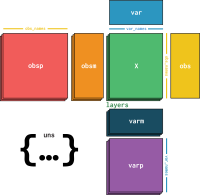


Analysis task-specific extensions
In addition to these packages, we define standards on how to represent certain data types in these data structures. For now, such a specification is available for Adaptive Immune Receptor Repertoire (AIRR) data.
Frameworks
Frameworks provide essential algorithms and plotting functions for specific analysis steps, building on our data structures.






Ecosystem packages maintained by scverse community
Many popular packages rely on scverse functionality. For instance, they take advantage of established data format standards such as AnnData and MuData, or are designed to be integrated into the workflow of analysis frameworks. Here, we list ecosystem packages following development best practices (continuous testing, documented, available through standard distribution tools).
This listing is a work in progress. See scverse/ecosystem-packages for inclusion criteria, and to submit more packages.
Convolutional autoencoder that learns spot representations from spatial transcriptomics by jointly integrating transcriptomics, morphology (H&E), and spatial-neighborhood topology. The learned embeddings support downstream tasks such as spatial-domain clustering and multi-modal analysis.

AnnData-based downstream proteomics analysis package with comprehensive support of search engine report formats. AlphaPeptTools features an io module for loading and standardizing MS-proteomics data, as well as pp, pl, tl and metrics modules to facilitate common proteomics-specific data processing, visualization and analysis tasks with a focus on metrics for evaluating the effect of different processing steps. Additionally, it features several example notebooks to demonstrate different proteomics use cases.
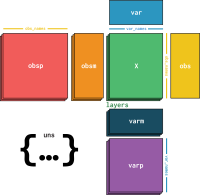
anndata is a Python package for handling annotated data matrices in memory and on disk, positioned between pandas and xarray. anndata offers a broad range of computationally efficient features including, among others, sparse data support, lazy operations, and GPU support.
⚠️ DEPRECATED: This package is deprecated in favor of anndataR. Please use anndataR for new projects. A ‘reticulate’ wrapper for the Python package ‘anndata’. Provides a scalable way of keeping track of data and learned annotations. Used to read from and write to the h5ad file format.

An R implementation of the AnnData object including native reading and writing of H5AD files and conversion to common R data structures.
Annsel is a user-friendly library that brings familiar dataframe-style operations to AnnData objects such as selection, filtering and group by’s.
Benchmarking tool for gene network inference from single cell RNAseq methods. It uses the grnndata/anndata modality and only contains biological ground truth networks
A Python toolkit for subcellular analysis of spatial transcriptomics data
biolord (biological representation disentanglement) is a deep generative framework for disentangling known and unknown attributes in single-cell data.
Cell BLAST is a cell querying tool for single-cell transcriptomics data.
Cell2location is a Bayesian model that can resolve fine-grained cell types in spatial transcriptomic data and create comprehensive cellular maps of diverse tissues. Cell2location accounts for technical sources of variation and borrows statistical strength across locations, thereby enabling the integration of single-cell and spatial transcriptomics with higher sensitivity and resolution than existing tools.
CellAnnotator is a lightweight tool to query large language models for cell type labels in scRNA-seq data. It can incorporate prior knowledge, and it creates consistent labels across samples in your study.
CellCharter is a framework to identify, characterize and compare spatial domains from spatial omics and multi-omics data.
CellMapper is a leightweight tool to transfer labels, expression values and embeddings from reference to query datasets using k-NN mapping. It’s fast and versatile, applicable to mapping scenarios in space, across modalities, or from an atlas to a new query dataset.
A computational tool that integrates single-cell transcriptome and epigenome profiles to infer gene regulatory networks (GRNs), critical regulators of cell identity.
CellphoneDB is a publicly available repository of HUMAN curated receptors, ligands and their interactions paired with a tool to interrogate your own single-cell transcriptomics data (or even bulk transcriptomics data if your samples represent pure populations!). A distinctive feature of CellphoneDB is that the subunit architecture of either ligands and receptors is taken into account, representing heteromeric complexes accurately. This is crucial, as cell communication relies on multi-subunit protein complexes that go beyond the binary representation used in most databases and studies. CellphoneDB also incorporates biosynthetic pathways in which we use the last representative enzyme as a proxy of ligand abundance, by doing so, we include interactions involving non-peptidic molecules. CellphoneDB includes only manually curated and reviewed molecular interactions with evidenced role in cellular communication.
CellRank is a toolkit to uncover cellular dynamics based on Markov state modeling of single-cell data. It contains two main modules - kernels compute cell-cell transition probabilities and estimators generate hypothesis based on these.
CZ CELLxGENE Annotate (pronounced “cell-by-gene”) is an interactive data explorer for single-cell datasets, such as those coming from the Human Cell Atlas.
Cirrocumulus is an interactive visualization tool for large-scale single-cell genomics data.
clone2vec is a Python package for analysis of lineage tracing coupled with single-cell RNA-Seq.
Cookiecutter template for scverse packages offering automated template sync
dandelion - A single cell BCR/TCR V(D)J-seq analysis package for 10X Chromium 5’ data. It streamlines the pre-processing, leveraging some tools from immcantation suite, and integrates with scanpy/anndata for single-cell BCR/TCR analysis. It also includes a couple of functions for visualization.

decoupler is a framework containing different enrichment statistical methods to extract biologically driven scores from omics data within a unified framework.
delnx is a python package for differential expression analysis of (single-cell) genomics data. It enables scalable analyses of atlas-level datasets through GPU-accelerated regression models and statistical tests implemented in JAX and provides a consistent interface to perform DE analysis with other methods, such as statsmodels and PyDESeq2.
Convenient and user-friendly package to streamline common workflows in single-cell RNA sequencing data analysis with improved visualisation
DoubletDetection is a Python3 package to detect doublets (technical errors) in single-cell RNA-seq count matrices.
DRVI is a tool for the unsupervised disentanglement and integration of single-cell omics. By providing interpretable latent dimensions, it allows users to identify cellular heterogeneity and biological processes beyond traditional cell types, identify rare cell types, and highlight developmental stages. DRVI is implemented using scvi-tools and includes a set of utility functions for interacting with latent dimensions.
Read/write functions to and from spatialdata for Deep Visual Proteomics
Inclusive model of expression dynamics with metabolic labeling based scRNA-seq / multiomics, vector field reconstruction, potential landscape mapping, differential geometry analyses, and most probably paths / in silico perturbation predictions.
Registry for scverse ecosystem packages (https://scverse.org/packages/#ecosystem)
EpiScanpy is a toolkit to analyse single-cell open chromatin (scATAC-seq) and single-cell DNA methylation (for example scBS-seq) data.
ESCHR is an ensemble clustering method that provides hard clustering along with uncertainty scores and soft clustering outputs for enhanced interpretability.
FAVA uses Variational Autoencoders to infer functional associations from large-scale scRNA-seq (and proteomics) data.
FlashDeconv is a high-performance spatial transcriptomics deconvolution tool that enables cell type mapping at atlas scale. Using structure-preserving sketching via randomized numerical linear algebra, FlashDeconv achieves linear time and memory complexity, processing 1 million spots in approximately 3 minutes on a standard laptop without GPU. It provides accurate cell type proportion estimation with Pearson r = 0.944 on the Spotless benchmark, and preserves rare cell type detection through leverage-score weighted sampling.
The complete FlowSOM package known from R, now available in Python! Analyze high-dimensional cytometry data using FlowSOM, a clustering and visualization algorithm based on a self-organizing map (SOM). FlowSOM is used to distinguish cell populations from cytometry data in an unsupervised way and can help to gain deeper insights in fields such as immunology and oncology.
Governance docs for scverse
GPTBioInsightor is a tool designed for single-cell data analysis, particularly beneficial for newcomers to a biological field or those in interdisciplinary areas who may lack sufficient biological background knowledge. GPTBioInsightor utilizes the powerful capabilities of large language models to help people quickly gain knowledge and insight, enhancing their work efficiency.
grassp (GRaph-based Analysis of Subcellular/Spatial Proteomics) is a Python module for fast, flexible, and scalable analysis of mass-spectrometry-based subcellular proteomics datasets. It uses the anndata format to store mass-spec data and results. scanpy is used for dimensionality reduction and visualization functions.
An overload of anndata to more easily work with gene networks. Allows easy conversion between anndata and grnndata and provide loads of useful utilities functions.
Single-cell gene set scoring with nearest neighbor graph smoothed data.
Hotspot is a tool for identifying informative genes (and gene modules) in a single-cell dataset.
illico runs fast, CPU-based, wilcoxon rank-sum tests to identify differentially expressed genes for single-cell RNA-seq data.
Infer copy number variation (CNV) from scRNA-seq data. Plays nicely with Scanpy.
A repo for integration testing core packages against upstream core packages
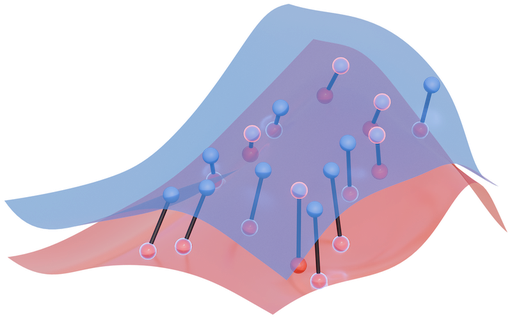
Statistical framework for holistic comparison of multi-condition single-cell datasets over continuous phenotypic manifolds. Kompot performs differential abundance and expression analysis agnostically to cell-type annotation or clustering, detecting differences that span the continuous manifold even when effects go in opposite directions across cell states. It models cell distributions and gene expression as continuous functions over cell state representations of arbitrary dimension (typically ~50 dimensions), enabling single-cell resolution inference with calibrated uncertainty estimates and capturing both global and cell-state-specific effects of perturbation.
LazySlide is a Python library for processing whole slide images (WSI) analysis. It provides a simple interface to perform robust preprocessing and advanced analysis for WSI.
Python package to infer cell-cell communication events from omics data using a collection of methods.
An information theoretic approach to detecting spatially varying genes
moscot is a scalable toolbox for multiomics single-cell optimal transport applications.
Paired single-cell multi-omics data integration with Optimal Transport-flavored Nonnegative Matrix Factorization

MuData is a format for annotated multimodal datasets where each modality is represented by an AnnData object. MuData’s reference implementation is in Python, and the cross-language functionality is achieved via HDF5-based .h5mu files with libraries in R and Julia.
A mechanistic model of gene expression that extends the popular RNA velocity framework by incorporating epigenomic data.

muon is a Python framework for multimodal omics analysis. It provides functionality for working with multimodal data, including preprocessing, integration, and visualization.
A Python package for PCA-based spatial domain identification in single-cell spatial transcriptomics data.
Graph-based foundation model for spatial transcriptomics data. Zero-shot spatial domain inference, batch-effect correction, and many other features.
OmicVerse is the fundamental package for multi omics included bulk and single cell analysis with Python. The original name of the omicverse was Pyomic, but we wanted to address a whole universe of transcriptomics, so we changed the name to OmicVerse, it aimed to solve all task in RNA-seq.
Palantir is an algorithm to align cells along differentiation trajectories. Palantir models differentiation as a stochastic process where stem cells differentiate to terminally differentiated cells by a series of steps through a low dimensional phenotypic manifold. Palantir effectively captures the continuity in cell states and the stochasticity in cell fate determination. Palantir has been designed to work with multidimensional single cell data from diverse technologies such as Mass cytometry and single cell RNA-seq.
A pipeline for multiomic single-cell and spatial transcriptomic data analysis
Implements Pareto task inference and archetypal analysis for analyzing functional trade-offs in single-cell and spatial omics data.
An open-source toolkit for computational pathology and machine learning.
physicell data output loader for downstream data analysis in python3.
periodicity evaluation in scATAC-seq data for quality assessment
Pegasus is a tool for analyzing transcriptomes of millions of single cells.

Pertpy is a framework for analyzing large-scale single-cell perturbation experiments. It harmonizes datasets, automates metadata annotation, calculates perturbation distances, and analyzes cellular responses to genetic modifications, drugs, and environmental changes.
PILOT is a Python library for Detection of PatIent-Level distances from single cell genomics and pathomics data with Optimal Transport.
p(opular)V(oting) is a consensus tool for transfering labels from an annotated reference dataset to an unannotated query dataset. Consensus calling allows interpretable scores that quantify certainty.
Pycea is a Python toolkit for single-cell lineage tracing analysis and visualization.
A python pacakge for chromVAR.
pyCrossTalkeR is a framework for network analysis and visualisation of LR networks. pyCrossTalkeR identifies relevant ligands, receptors and cell types contributing to changes in cell communication when contrasting two biological states: disease vs. homeostasis.
PyDESeq2 is a python package for bulk RNA-seq differential expression analysis. It is a re-implementation from scratch of the main features of the R package DESeq2 (Love et al. 2014).
Python implementation of the LEMUR algorithm for analyzing multi-condition single-cell RNA-seq data..
pySCENIC is a lightning-fast python implementation of the SCENIC pipeline (Single-Cell rEgulatory Network Inference and Clustering) which enables biologists to infer transcription factors, gene regulatory networks and cell types from single-cell RNA-seq data.
A Python port of the tximport R package for importing transcript-level quantification data from various RNA-seq quantification tools such as salmon and kallisto and summarizing it to the gene level.
pyUCell is a package for evaluating gene signatures in single-cell datasets. pyUCell signature scores, based on the Mann-Whitney U statistic, are robust to dataset size and heterogeneity, and their calculation demands less computing time and memory than other available methods, enabling the processing of large datasets in a few minutes even on machines with limited computing power.
rapids-singlecell is a GPU-accelerated single-cell analysis library that serves as a drop-in replacement for scanpy, squidpy, and decoupler.
Rectangle is a python package for computational deconvolution. Rectangle presents a novel approach to second-generation deconvolution, characterized by hierarchical processing, an estimation of unknown cellular content and a significant reduction in data volume during signature matrix computation.
SC2Spa is a deep learning-based tool for predicting the spatial coordinates of single cells based on transcriptome. Two paired single cell and spatial transcriptomic datasets are required to run SC2Spa. SC2Spa is trained on a ST reference dataset to learn the relationship of gene expression and spatial coordinates. The trained fully-connected neural network can be used to predict the locations of a single cell with only the transcriptomic profile as input. The predicted locations of single cells can be further used to study the communication of the single cells.
SCALEX is an integration and projection tool for atlas-level single-cell RNA-seq and ATAC-seq data.
robust cell proportion analysis for single cell data

Scanpy is a scalable toolkit for analyzing single-cell gene expression data built jointly with anndata. It includes preprocessing, visualization, clustering, trajectory inference and differential expression testing. The Python-based implementation efficiently deals with datasets of more than one million cells.
scCellFie infers metabolic activities from single-cell and spatial transcriptomics and offers a variety of downstream analyses.
A dataloader for large single cell databases like cellxgene. Does weighted random sampling, downloading and preprocessing. works with anndata, zarr, and h5ad files.
A scalable python package for tree inference and advanced pseudotime analysis from scRNAseq data.
scGen is a generative model to predict single-cell perturbation response across cell types, studies and species.
schist applies Stochastic Block Models (SBM) to the analysis of single cell data, in particular to identify cell populations
Evaluating single-cell data integration methods
GPU-accelerated single-cell integration benchmarking metrics using RAPIDS (cuML, CuPy) as a drop-in replacement for the JAX-based metrics in scib-metrics.

Scirpy is a scalable toolkit to analyse T-cell receptor or B-cell receptor repertoires from single-cell RNA sequencing data. It seamlessly integrates with scanpy and provides various modules for data import, analysis and visualization.
A MCP server hub for scRNA-Seq analysis software.
A single cell foundation model for Gene network inference and more…
A next generation single cell foundation model
Python package to mix-and-match conflicting clustering results in single cell analysis and generate reconciled clustering solutions
scVelo is a scalable toolkit for RNA velocity analysis in single cells, based on Bergen et al., Nature Biotech, 2020.
Tutorials and tutorials registry for scverse.org/learn.
scverse.org website

scvi-tools is a library for developing and deploying machine learning models based on PyTorch and AnnData. With an emphasis on probabilistic models, scvi-tools streamlines the development process via training, data management, and user interface abstractions. scvi-tools also contains easy-to-use implementations of more than 14 state-of-the-art probabilistic models in the field.
Single-cell Cross Match (scxmatch) is a is a Python package that implements Rosenbaum’s cross-match test using distance-based matching to assess distribution shifts between two groups of high-dimensional data. This is particularly useful in analyzing multivariate distributions in structured data, such as single-cell RNA-seq or ATAC-seq.
scXpand is a machine learning framework for pan-cancer detection of T-cell clonal expansion directly from single-cell RNA sequencing (scRNA-seq), without paired T-cell receptor (TCR) sequencing.
Biology-driven deep generative model for cell-type annotation in cytometry. Scyan is an interpretable model that also corrects batch-effect and can be used for debarcoding or population discovery.
SiFT is a computational framework which aims to uncover the underlying structure by filtering out previously exposed biological signals. SiFT can be applied to a wide range of tasks, from (i) the removal of unwanted variation as a pre-processing step, through (ii) revealing hidden biological structure by utilizing prior knowledge with respect to existing signal, to (iii) uncovering trajectories of interest using reference data to remove unwanted variation.
sincei provides a flexible, easy-to-use command-line interface and python API to work with single-cell epigenomics data directly from BAM files. It can: Aggregate signal in bins, genes or any feature of interest from single-cells. Perform read-level and count-level quality control. Perform dimensionality reduction and clustering of various types of single-cell data (open chromatin, histone marks, methylation etc..). Create coverage files (bigwigs) for visualization.

SnapATAC2 is a scalable and modular pipeline for analyzing single-cell ATAC-seq data, enabling efficient preprocessing, dimensionality reduction, clustering, and integration with single-cell RNA-seq.
Sobolev alignment of deep probabilistic models for comparing single cell profiles from pre-clinical models and patients
Technology-invariant pipeline for spatial-omics analysis that scales to millions of cells. It includes segmentation, annotation, spatial statistics, and efficient visualization.
Python package designed to transfer information from multiple spatial-transcriptomics data sets to a single reference representing a Common Coordinate Framework (CCF).

SpatialData is a data framework that comprises a FAIR storage format and a collection of python libraries for performant access, alignment, and processing of uni- and multi-modal spatial omics datasets.
Spatialproteomics is an interoperable toolbox for analyzing highly multiplexed fluorescence image data. This analysis involves a sequence of steps, including segmentation, image processing, marker quantification, cell type classification, and neighborhood analysis.
spatiomic is a computational library for the analysis of spatial proteomics, mainly via pixel-based clustering, differential cluster abundance analysis and spatial statistics.

Squidpy is a tool for the analysis and visualization of spatial molecular data. It builds on top of scanpy and anndata, from which it inherits modularity and scalability. It provides analysis tools that leverages the spatial coordinates of the data, as well as tissue images if available.
Statistics for scverse
Gene-centric spatial transcriptomics for deciphering complex spatial omics data
Symphonypy is a pure Python port of Symphony label transfer algorithm for reference-based cell type annotation.
Spatial alignment and gene expression mapping of single cell transcriptomic data.
Evolutionary graph community detection combining genetic search with Leiden refinement, with native support for clustering Scanpy neighbor graphs stored in AnnData.
TreeData is a lightweight wrapper around AnnData which adds two additional attributes, obst and vart, to store nx.DiGraph trees for observations and variables.
Vitessce is an integrative visualization framework for multimodal and 2D/3D spatially resolved single-cell data. It consists of reusable, interactive linked views including scatterplot embedding views, 2D/3D spatial image views, genome browser tracks, statistical plots, and control views, built on web technologies such as WebGL and WebXR.
wsidata is a data-structure for efficient IO of Whole Slide Images based on spatialdata.

An Bioconductor R package that enables reading and writing of H5AD files and conversion between AnnData and SingleCellExperiment objects by wrapping the Python anndata package.
No packages match your filters.